
| 未和火箭分离,俄国损失周六发射的潜艇探测卫星 |
| 送交者: 2015年12月08日03:08:05 于 [世界军事论坛] 发送悄悄话 |
|
|
New Russian military satellite declared lost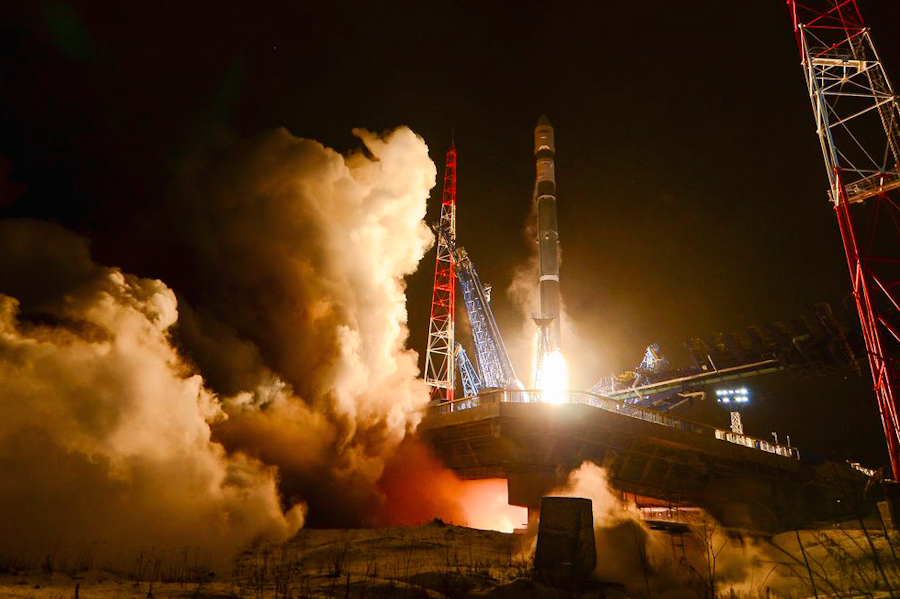 Russia’s Soyuz 2-1v rocket blasted off at 1409 GMT (9:09 a.m. EST) Saturday from the Plesetsk Cosmodrome in northern Russia. Credit: Russian Ministry of Defense A Russian defense payload built to monitor maritime activity, and possibly track the movements of submarines, is stuck to the upper stage of its rocket after launching Saturday from the Plesetsk Cosmodrome, multiple Russian news agencies reported. The Kanopus ST spacecraft is still attached to the Volga upper stage of a modified Soyuz rocket that was supposed to deploy the satellite into a circular sun-synchronous orbit nearly 700 kilometers (435 miles) above Earth, and experts said Monday the craft is heading for a destructive re-entry within a few days. Russia’s Tass news agency and the Kommersant newspaper reported the satellite could not be separated from the Volga upper stage, which made its second flight Saturday after a successful debut in 2013. One of four locks holding the Kanopus ST satellite failed during the separation sequence, and ground controllers have been unable to contact the craft and re-issue the separation command, the state-owned Tass news agency said Monday. Tracking data published by the U.S. military showed an object believed to be the Volga upper stage — with the attached Kanopus ST satellite — in an elliptical orbit with a low point 104 kilometers (64 miles) above Earth. At such a low altitude, atmospheric drag will hasten the craft’s re-entry, which is expected some time this week, according to Jonathan McDowell, an astronomer and respected space analyst. The Volga upper stage maneuvered from Kanopus ST’s intended orbit into the lower orbit some time after Saturday’s launch. The rocket burn may have intended to send the rocket body toward a guided re-entry over the ocean, but the extra mass of the still-attached Kanopus ST satellite could have prevented the stage from reaching its targeted trajectory. A small passive secondary payload designed to help calibrate ground-based military radars apparently deployed as planned from the Volga upper stage in the correct orbit. A re-entry prediction released Monday from the U.S. military’s Joint Space Operations Center indicated the Volga/Kanopus ST spacecraft could plunge back into Earth’s atmosphere as soon as Tuesday. The Kanopus ST satellite carries a camera and a microwave radiometer to monitor the world’s oceans, including submarine movements, according to RussianSpaceWeb.com. The mission launched Saturday on a Soyuz 2-1v rocket, a derivative of Russia’s Soyuz rocket family without the launcher’s four liquid-fueled strap-on boosters. The Soyuz 2-1v’s core stage has a single NK-33 engine taken from stockpiles of kerosene-fed powerplants originally built for the Soviet Union’s N1 moon rocket more than 40 years ago. Saturday’s launch was the first time a version of the NK-33 engine flew since the crash of an Orbital ATK Antares rocket in October 2014. Investigators blamed that accident on an explosion inside the turbopump of one of its AJ26 engines, an “Americanized” variant of the NK-33. The NK-33 engine on Saturday’s flight apparently functioned as designed. |
|
|
 |
 |
| 实用资讯 | |
|
|
| 一周点击热帖 | 更多>> |
| 一周回复热帖 |
| 历史上的今天:回复热帖 |
| 2014: | 中国人口问题其实已经进入麻烦期但大部 | |
| 2014: | 中国水泥用量不得了,过去三年用量等于 | |
| 2013: | ​原创:美国登月为什么举国造 | |
| 2013: | 中乌联合声明:中国承诺向乌克兰提供核 | |
| 2012: | 极为罕见 习近平打开车窗向民众挥手(图 | |
| 2012: | 西沙海战南越方指挥官何文锷上校回忆录 | |
| 2011: | 请教一个问题,晚上对面来车50%以上开大 | |
| 2011: | 79年首批留美人员:纽约党委怎么管纽约时 | |
| 2010: | 请谁来回答一个问题 | |
| 2010: | 椭圆太黑的保温杯原理可能是这样的: | |